What we found reviewing 330 local-business websites
We reviewed the home pages of 330 business websites in Guadalajara, Querétaro and Monterrey. Here is what we saw and what we can’t claim.
By Adrián Martínez · · 6 min read
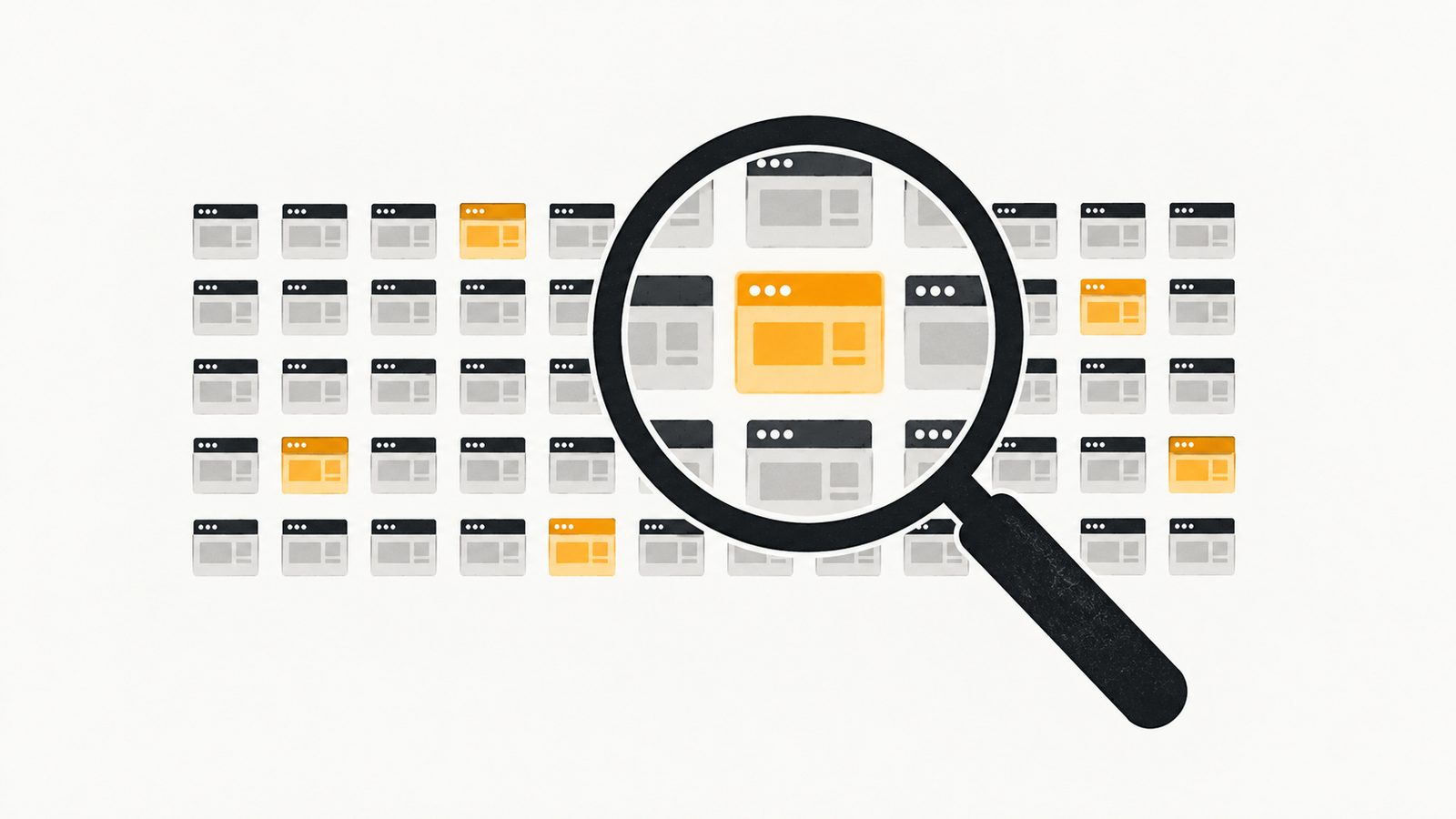
The basics are almost always in place: 98% of the sites use https and 99% adapt to a phone screen. What is missing most is what you can’t see at a glance: the structured-data profile that describes the business to machines, and opening hours written on the page. We reviewed the home page of 330 local-business websites. This article explains how we did it, what came out and, just as important, what those numbers cannot tell you.
What we checked and how
It was a mechanical review: a program downloaded each site’s home page and looked for specific signals in the code. Nobody judged design or the quality of the writing, and we did not use artificial intelligence to classify anything. It was carried out on 20 October 2026.
- Sample: 330 sites with their own domain, 110 per city (Guadalajara, Querétaro and Monterrey, including their metro areas), across 34 different types of business. We gathered 405 candidates with a web search tool and drew a random sample from them.
- Left out: directories, social networks, marketplaces, booking platforms, national chains and franchises, and sites that live on a subdomain of a site builder.
- How each site was checked: one request to the home page and one to the robots.txt file, at a pace of one per second and with a clear identifier. Nothing on the site was executed and no business was contacted.
- Connection results: 324 of the 330 sites responded. Every percentage below is calculated on those 324, except robots.txt, which is calculated on the 285 files we were able to read.
A robots.txt file is the note a site leaves for search-engine and AI-assistant crawlers, telling them what they may visit. Structured data is something else: a hidden profile in the code that describes your business in a format machines can read without guessing. We explain it calmly in the article about that hidden profile.
What we found
| Signal on the home page | Sites | Share |
|---|---|---|
| Use https | 322 of 330 | 98% |
| Include the tag that adapts the page to phones | 321 | 99% |
| Show an address or phone number written as text | 292 | 90% |
| Have structured data in JSON-LD format | 221 | 68% |
| Have no JSON-LD or schema.org microdata | 93 | 29% |
| Don’t declare a local business type in their JSON-LD | 213 | 66% |
| Show no detectable opening hours in the text | 149 | 46% |
| Have fewer than 1,500 characters of visible text | 26 | 8% |
| Meet six basic signals at once (see below) | 50 | 15% |
Review of 330 local-business websites in Guadalajara, Querétaro and Monterrey, 20 Oct 2026. Basic signals from the home page; does not measure rankings.
Shares are calculated on the 324 sites that responded; https is the exception, calculated on all 330. Three readings hold up against that table.
The hidden profile: common, but almost always generic
221 sites had structured data, but 110 of them only used generic types, or types unrelated to a local business. And 213 sites, two out of three, did not declare what kind of business they are: nothing in that format said “I am a clinic” or “I am a restaurant”. Another 93 had no profile of any kind.
Contact details are visible but not labeled
292 sites showed an address or phone number in the text. In 192 of them, no local-business type repeated those details in the profile. For a person the site makes sense; for a machine, the label that ties the details together is missing.
Opening hours are what is missing most
On 149 sites we found no opening hours written on the home page. Mind the exact phrasing: we are not saying those businesses don’t publish their hours. They may be on another page, in an image or on their Google listing. All we know is that they were not in the text of the home page.
About the six-signal row: we put together a local-business profile, an address or phone number in the text, opening hours, a main heading, the phone-screen tag and at least 1,500 characters of text. It is a combination we chose in order to summarize, not anyone’s standard. Only 50 of the 324 sites meet all of it.
And your site, how many signals does it meet?
If you want us to review yours with the same list and tell you what is missing, write to us and we will go through it with you.
What this study does not say
A review like this invites exaggerated conclusions, so let’s stop them at the start. These are things you cannot claim from this data:
- That Google or AI assistants can’t understand these sites. We measured signals in the home page code, not how each search engine interprets them.
- That any business appears, or fails to appear, on Google or in ChatGPT. We did not measure rankings or mentions.
- That one city or type of business does better or worse than another. Differences between cities fall within the margin of error, and each type of business has between 3 and 21 sites, too few to compare.
- That the results represent every business in Mexico. The sample comes from a web search tool and leaves out anyone who only has social media or a map listing. It plausibly over-represents better-built sites, so the real picture could look worse.
There are technical limits too. We looked only at the home page, on a single day, and we did not run JavaScript: a site that builds its profile or its text with JavaScript may show up here as incomplete when it isn’t. Detecting addresses and hours with text patterns can fail in both directions. And if you repeated the review tomorrow, the figures would come out slightly different, because sites change.
How to read these figures
They are an inventory of basic signals, not a diagnosis of visibility. They help you decide what to check on your own site, not how you are doing on Google.
Why the hidden profile deserves attention, without overstating it
Google describes structured data as a standardized format for providing information about a page and classifying its content, and it recommends JSON-LD when your site allows it. It also states that it does not guarantee that features built on structured data will show up in results: the markup can make a page eligible for certain features, nothing more.
For AI results, Google is even more direct. It says there are no additional requirements to appear in AI Overviews or AI Mode, that you don’t need new machine-readable files, AI text files or special markup, and that a page has to be indexed and eligible to be shown with a snippet, with indexing and serving never guaranteed. So we won’t tell you that completing the profile gets you into ChatGPT. What is true is that a complete profile that matches what the page says is clearer information about your business, and leaving it empty means passing up an easy hint to give.
What the “hidden profile” of your website isIf you want to understand what that profile is and what it looks like inside, start here. →What you can check on your site today
With this study’s list you can run your own review in twenty minutes, no technical skills needed. Start with what anyone can see:
- Are your address, phone number and opening hours written as text on the home page, or only inside an image?
- Does your page open over https and look right on a phone?
- Does it have a main heading that says what you do and where?
- Does it have structured data? Open your page, right-click, choose “View page source” and search for the word ld+json. If it doesn’t appear, there is probably no profile.
Google offers the Rich Results Test to validate local-business markup, and the URL Inspection tool in Search Console to see how Google sees a page that is already live. With those two you will know what is there and what is missing before paying anyone.
Checklist: 10 points to check on your home page todayHere is the complete ten-point list, to go through with your page open. →Byte and Brand websitesIf you would rather have the new site born with the profile complete, the text as text and the hours in plain view, that is how Byte and Brand sites are built. →Let’s review your site with this same list
Tell us which site is yours and we will tell you, frankly, which signals it lacks and whether it is worth fixing them or starting over.